Spondylolisthesis
Learn about spondylolisthesis, a condition where vertebrae slip out of position. Understand symptoms, diagnosis methods, and available treatment options.
Spondylolisthesis: Slipped Vertebra Symptoms, Diagnosis & Treatment
Introduction
Spondylolisthesis is a condition that occurs when the bones of the spine, or vertebrae, "slip" and shift in position relative to one another (1). Though this condition is most common in older individuals with aging and gradual wear and tear of the spine, younger individuals, particularly those who participate in sports requiring frequent hyperextension of the back (e.g., gymnastics) are also at risk (2). This article discusses the symptoms associated with spondylolisthesis, how the condition is diagnosed, and treatment options available to help.
Understanding Spondylolisthesis
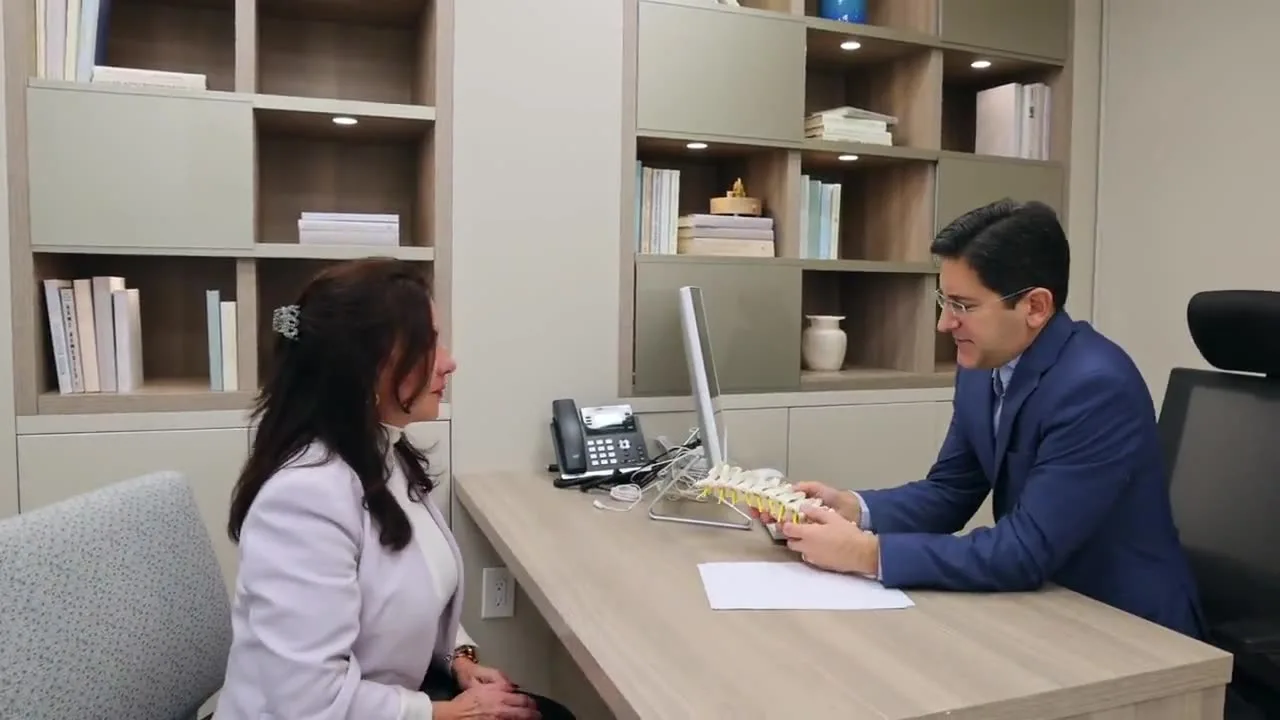
Watch this educational video to learn more about spondylolisthesis, its causes, and how it may affect your daily life.
Symptoms
Most cases of spondylolisthesis are asymptomatic and discovered incidentally on imaging completed for other concerns. When patients do display symptoms, they most often report back pain that may be accompanied by shooting pains down the arm or leg (1,2).
Patients with degenerative (age-related) spondylolisthesis often report signs of neurogenic claudication (3), including:
- Pain in the buttocks or legs
- Pain worsens with standing or walking
- Pain is relieved by bending the spine or sitting down
Diagnosis
Spondylolisthesis is diagnosed with X-Ray of the region of the back involved, most often the lumbar (lower) spine. Often, multiple views of the spine are needed to best capture the anatomy and determine whether there is evidence of vertebral slippage (1).
Patients with signs of neurologic dysfunction (shooting pain, numbness/tingling, or weakness in one or more of the extremities) may require further evaluation with MRI (2).
Treatment Options
Conservative management is recommended as first-line treatment for spondylolisthesis, which can include:
- Physical therapy building strength in spine flexion
- Activity modification
- NSAIDs (Ibuprofen [Advil™], Naproxen [Aleve™]) for pain relief
- Steroid injections
While the majority of patients with spondylolisthesis improve without the need for surgery, some patients may have persistent or worsening symptoms despite using conservative management strategies. In these patients (and those with evidence of neurologic compromise), surgical decompression of the spine is considered.
Spinal decompression can be performed with and without vertebral fusion, or the attachment of the slipped bones in question to prevent further instability and slippage.
Important
If you are experiencing symptoms that you believe may be concerning for spondylolisthesis, you should discuss them with a licensed healthcare provider to determine what treatment options may be best for you.
MRI for Spine Conditions
Learn how MRI imaging is used to diagnose spondylolisthesis and other spine conditions, helping your doctor develop an effective treatment plan.
References
- https://pubmed.ncbi.nlm.nih.gov/35597059/
- https://pubmed.ncbi.nlm.nih.gov/36526328/
- https://www.nejm.org/doi/full/10.1056/NEJMoa070302
- https://www.aafp.org/pubs/afp/issues/2023/1200/sports-related-overuse-injuries.html
Ready to Discuss Your Condition?
Contact our team to schedule a consultation and learn more about treatment options tailored to your needs.
Individual patient results vary. This information is educational and not a substitute for professional medical advice.