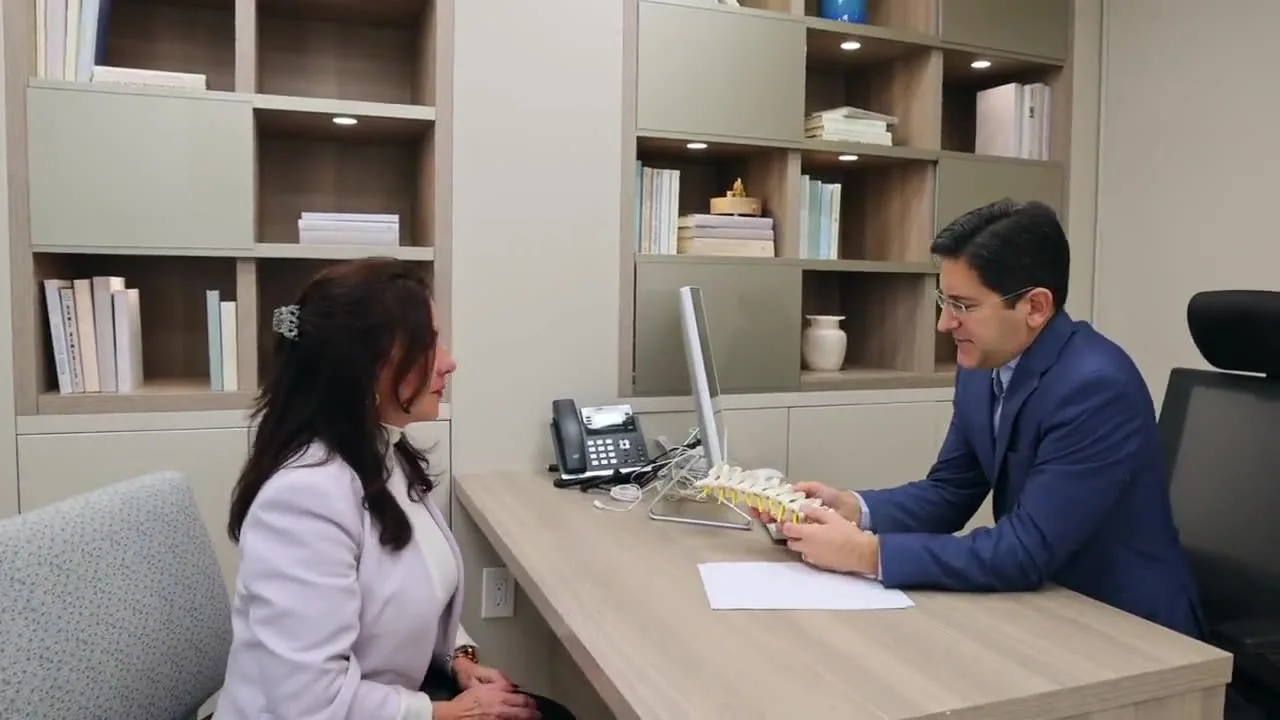
Cervical Spine Fusion
Comprehensive guide to cervical spine fusion covering surgical techniques, recovery timeline, and what to expect for neck fusion procedures.
Cervical Spine Fusion: Neck Fusion Options & Recovery - Anterior & Posterior Approaches
Introduction
Cervical Spine Fusion is a surgical technique used to provide additional stability to the neck and upper spine. Surgeons typically do not perform cervical spine fusion as an isolated procedure but rather as one part of treatment for an underlying condition causing instability or deformity in the upper spine. This article discusses some of the techniques used for Cervical Spine Fusion along with expectations for recovery following a fusion procedure. Each case is unique, and if you are considering a spine fusion procedure, you should discuss your particular concerns with a licensed healthcare provider.
Anterior Cervical Discectomy and Fusion (ACDF)
Watch this educational video to learn how ACDF removes a damaged cervical disc and stabilizes the neck with fusion.
Techniques
Cervical Spine Fusion is traditionally completed with open, anterior approaches, meaning surgeries completed through direct visualization of the spine through the front of the neck. With the rapid evolution of technology and techniques for minimally invasive surgery, some Cervical Spine Fusion procedures now use a posterior (from the back) approach. These techniques are frequently aided by high powered cameras and other instruments and have been shown to have comparable if not better outcomes when compared to anterior approaches (1)
Anterior Cervical Discectomy and Fusion (ACDF)
ACDF is typically completed in the setting of disc herniation with fusion performed to stabilize the spine postoperatively. Surgeons access the upper spine from the front of the body and may use graft tissue or a fixed cage to add additional stability to the vulnerable area of the spine. Though traditionally an open technique, minimally invasive techniques are also available in some cases. (2, 3)
Anterior Cervical Corpectomy and Fusion (ACCF)
ACCF is performed for patients with vertebral compression or multi-level disc disease (where there are issues with disc function or position at multiple adjacent vertebral levels). Similar to ACDF, ACCF is completed from the front and is traditionally performed as an open surgery, though minimally invasive techniques are also sometimes used. (4)
Laminectomy with Fusion
Laminectomy with fusion is a dorsal approach that utilizes a posterior or dorsal approach to remove the lamina, part of the vertebrae, and attach two adjacent vertebrae for additional stability. This technique is often used for patients with cervical myelopathy (cord compression) or spondylolisthesis (vertebral slippage). (1)
Minimally Invasive Posterior Cervical Fusion (MIS-PCF)
Minimally invasive surgical techniques use high powered cameras and machinery to reduce the need for large incisions and improve recovery time. In MIS-PCF, surgeons used these cameras to allow for improved access to the upper spine and neck from the back. (5)
Recovery Timeline
Recovery following spine fusion varies depending on the surgery performed, the spine operated on, and the person undergoing surgery. Patient recovery typically occurs in three phases. In the first weeks after surgery, patients will typically experience rapid recovery. On average, patients undergoing anterior cervical fusion procedures will leave the hospital after three days, and those receiving posterior fusion will have hospital stays closer to nine days, however these statistics also reflect statistical outliers with longer stays. For example, the majority of patients undergoing anterior cervical fusion will be released on Post-Operative Day 1 (POD1) (6). Following release from the hospital, patients typically are able to discontinue the use of opioid pain medications after one week and return to activities like driving at two to three weeks post-operation (7). Following the initial period of rapid recovery, patients will continue to rehabilitate at a moderate pace for several months. During this period, clinicians will be able to provide more meaningful predictions about long-term outcomes, though the vast majority of patients undergoing cervical fusion procedures demonstrate improved mobility and decreased pain both one year and two years after surgery (8).
Laminectomy (Cervical Spine, With Fusion)
Learn how posterior cervical laminectomy with fusion can decompress the spinal cord and stabilize the cervical spine.
Citations
- https://jamanetwork.com/journals/jama/fullarticle/2777236?utm_source=openevidence&utm_medium=referral
- https://pubmed.ncbi.nlm.nih.gov/21249667/
- https://pubmed.ncbi.nlm.nih.gov/29058045/
- https://pubmed.ncbi.nlm.nih.gov/17436916/
- https://pubmed.ncbi.nlm.nih.gov/39950783/
- https://pubmed.ncbi.nlm.nih.gov/29438790/
- https://pubmed.ncbi.nlm.nih.gov/37728119/
- https://pubmed.ncbi.nlm.nih.gov/29741718/
Interested in This Treatment?
Contact our team to schedule a consultation and learn more about whether this treatment may be appropriate for you.
Individual patient results vary. No outcome is guaranteed. This information is educational and not a substitute for professional medical advice.