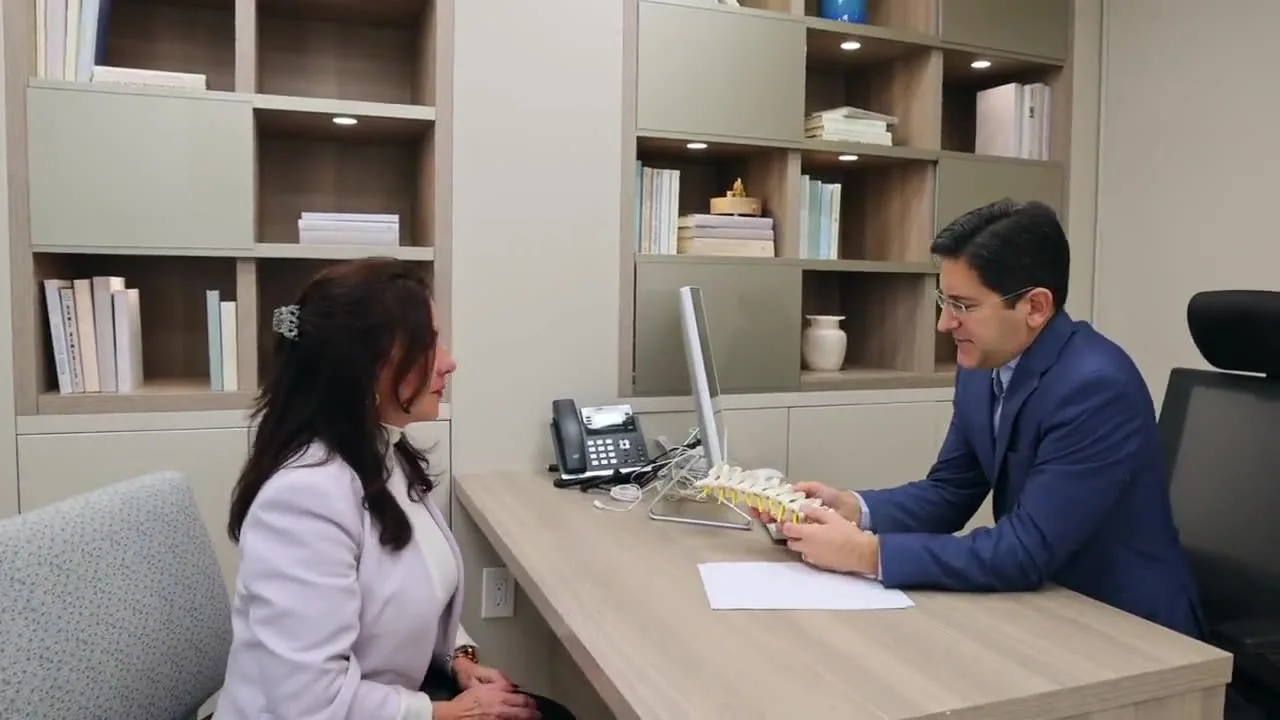
Lumbar Disc Replacement
Comprehensive guide to lumbar disc replacement including patient selection, device options, and recovery expectations for artificial disc surgery.
Lumbar Disc Replacement: Artificial Disc Surgery and Recovery
Introduction
Lumbar Disc Replacement (LDR) surgery, sometimes referred to as Lumbar Disc Arthroplasty, has come a long way since initial attempts to replace dysfunctional discs in the lower spine with metal balls in the 1960s (1). After decades of experimentation and innovation, the FDA approved modern LDR techniques in 2004, and since, disc replacement has shifted from an experimental approach to standard of care in appropriate patients with degenerative disc disease not responsive to conservative management (2). This article provides an overview of how surgeons determine who would benefit from LDR, what devices are used for LDR, and what to expect for recovery following surgery. For more information on whether disc replacement is right for you, discuss the specifics of your case with a licensed healthcare professional.
Artificial Disc Replacement (Lumbar Spine)
Watch this educational video to learn how artificial disc replacement in the lumbar spine can preserve motion at a treated level.
Who is LDR for?
Disc Replacement is a serious procedure that should only be performed for people with degenerative lumbar disc disease who have tried conservative management strategies centering physical therapy and functional recovery (3). Other considerations include (3-5):
- Disease limited to one or two disc levels
- Pain/mobility issues driven primary by disc disease
- Preserved disc height
- Absence of facet joint arthritis (wear down of joints between adjacent vertebrae)
- No significant spinal instability or deformity
Techniques
Two devices are currently FDA-approved for use in the United States, though other options may be available abroad. The devices available on the US market are as follows (4):
- CHARITÉ Artificial Disc: one of the first devices approved; uses a ball-and-socket design
- ProDisc-L: also widely used across the US; uses a ball-and-socket design with mobile core to improve post-operative flexibility
Newer, experimental models have explored the use of elastic materials to more closely mirror the structure of the spinal discs removed. These devices are not yet available on the US market beyond experimental trials, however you should discuss with your surgeon what option is best for you.
Recovery Timeline
Following LDR, patients are encouraged to resume walking as soon as they are physically able, though it may take time to be able to move around without limitations from pain or loss of muscle mass (6). Those with sedentary jobs may be able to return to work as soon as one week after surgery, though patients will take on average 4.8 weeks to return to work following disc replacement surgery (7). Patients will typically begin physical therapy 2-4 weeks after surgery and will experience continued improvements in pain and mobility as they engage in recovery-oriented care. Pain management strategies can vary, though many patients are able to discontinue the use of narcotic pain medications by four weeks postoperatively (6). Long term outcomes are strong, and over 70% of appropriately selected patients have lasting improvement in pain, mobility, or both from LDR surgery at five years following their operation (8).
Lumbar Disc Replacement (Charité)
Learn about lumbar disc replacement using the Charité artificial disc design as an example of ball-and-socket disc arthroplasty.
Citations
- https://pubmed.ncbi.nlm.nih.gov/31724719/
- https://pubmed.ncbi.nlm.nih.gov/29176485/
- https://pubmed.ncbi.nlm.nih.gov/28987839/
- https://journals.lww.com/joem/fulltext/2021/04000/invasive_treatments_for_low_back_disorders.19.aspx
- https://pubmed.ncbi.nlm.nih.gov/16924209/
- https://pubmed.ncbi.nlm.nih.gov/31790063/
- https://pubmed.ncbi.nlm.nih.gov/31790063/
- https://pubmed.ncbi.nlm.nih.gov/21857395/
Interested in This Treatment?
Contact our team to schedule a consultation and learn more about whether this treatment may be appropriate for you.
Individual patient results vary. No outcome is guaranteed. This information is educational and not a substitute for professional medical advice.