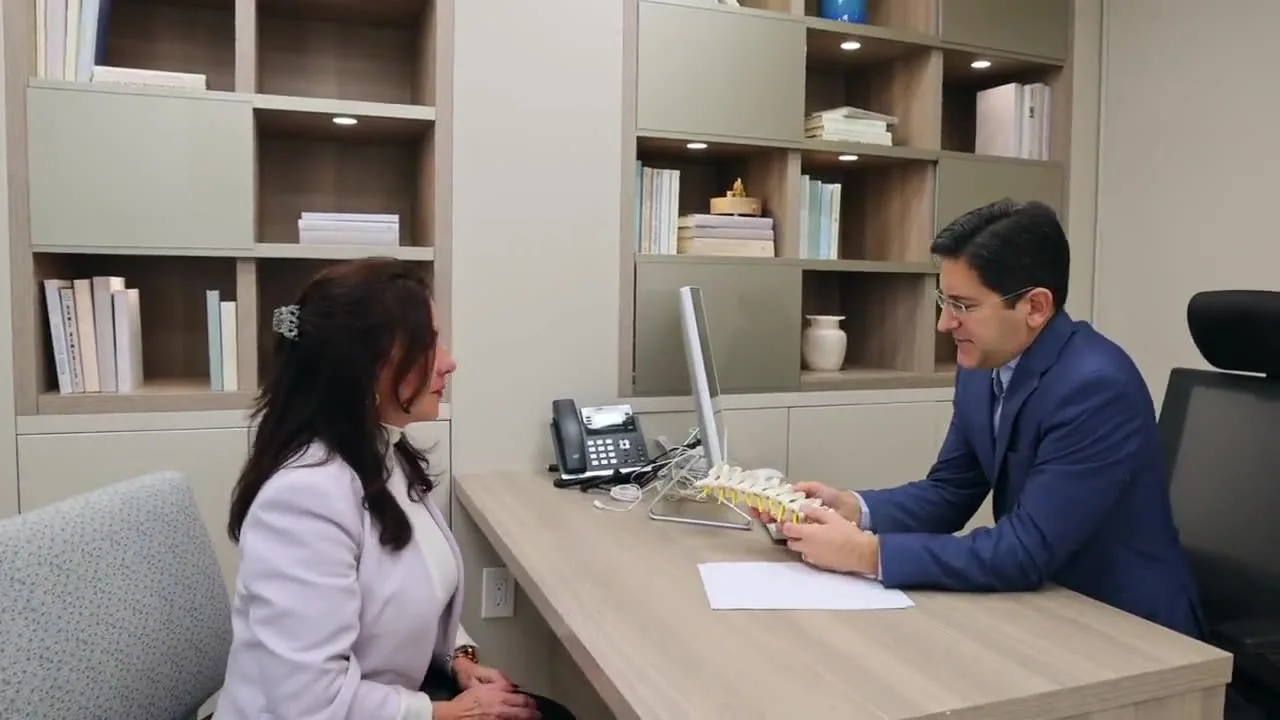
Spine Fusion
Learn about spine fusion surgery including indications, surgical techniques, and recovery expectations. Comprehensive guide for patients considering fusion procedures.
Spine Fusion: Why It's Done, Techniques, and Recovery Timeline
Introduction
Spine fusion has become increasingly popular in the United States, with elective lumbar fusion procedures rising over 60% from 2004 to 2015 (1). Despite surgeons' growing use of this procedure, up to 40% of patients do not receive adequate preoperative counseling informing them of their options for surgery and the specific risks and benefits to spine fusion for their case (2). This article discusses some of the common indications for spine fusion ("Why It's Done"), techniques used for fusion procedures, and expectations for recovery. Each case is unique, and if you are considering a spine fusion procedure, you should discuss your particular concerns with a licensed healthcare provider.
Spinal Fusion (Lumbar)
Watch this educational video to learn how lumbar spinal fusion is performed and how it stabilizes the lower spine.
Why It's Done
Spine fusion is used to add structure to a region of the spine that is unstable, deformed, or breaking down due to a selection of degenerative spine diseases (3). Some of the specific conditions commonly treated with spine fusion include (4):
- Degenerative spondylolisthesis with evidence of instability*
- High grade spondylolisthesis
- Degenerative scoliosis
- Trauma, infection, or tumor growth causing instability
Spine fusion may also be performed after laminectomy in the setting of spinal stenosis or disc herniation, but this is less common and most often performed due to secondary instability. Similarly, spinal fusion may be used following cervical discectomy done for disc herniation, particularly when spondylosis is also present (5).
Techniques
Surgeons can take a variety of approaches to spine fusion, broadly divided between traditional ("open") approaches and minimally invasive techniques. Lumbar (lower) spine fusion is typically completed with posterior approaches (from the back), though cervical (upper) spine fusion is often performed from an anterior (frontal) approach. For more information on the techniques discussed, click on the subheadings below!
Posterior Lumbar Interbody Fusion (PLIF)
PLIF is the most traditional approach. It is an open technique where surgeons access the spine region of interest directly from the back.
Transforaminal Lumbar Interbody Fusion (TLIF)
TLIF is an open approach where surgeons access the spine region of interest from the back, though it involves a more lateral approach to the spine itself. It can also be performed with minimally invasive techniques, where it is referred to as MIS-TLIF.
Anterior Cervical Discectomy and Fusion (ACDF)
ACDF is typically completed in the setting of disc herniation with fusion performed to stabilize the spine postoperatively. Surgeons access the upper spine from the front of the body and may use graft tissue or a fixed cage to add additional stability to the vulnerable area of the spine. Though traditionally an open technique, minimally invasive techniques are also available in some cases.
Anterior Cervical Corpectomy and Fusion (ACCF)
ACCF is performed for patients with vertebral compression or multi-level disc disease (where there are issues with disc function or position at multiple adjacent vertebral levels). Similar to ACDF, ACCF is completed from the front and is traditionally performed as an open surgery, though minimally invasive techniques are also sometimes used.
Minimally Invasive Surgery (MIS)
Minimally invasive surgical techniques use high powered cameras and machinery to reduce the need for large incisions and improve recovery time. They are often modeled off of or combined with strategies used for traditional, open approaches to fusion surgery. Specific types of minimally invasive spine fusion include MIS-TLIF (TLIF using endoscopy or other high powered cameras) and MIS-PCF (minimally invasive posterior cervical fusion), among others. If you are curious about specific minimally invasive techniques, you should discuss available options with an expert in spine surgery.
Recovery Timeline
Recovery following spine fusion varies depending on the surgery performed, the spine operated on, and the person undergoing surgery. Nonetheless, patients undergoing fusion procedures can expect gradual recovery lasting months to a year (6). In general, patients undergoing minimally invasive surgery have shorter hospital stays than those receiving open surgery. Early mobilization begins shortly after release from the hospital, with rigorous physical therapy often needed to ensure maximum return to mobility and function (7). Most patients experience their most dramatic improvements in pain and ability up to six months after their operation, though many will continue to see improvements in the months following this period (6).
Anterior Cervical Discectomy and Fusion (ACDF)
Learn how ACDF is used in the neck to remove a damaged disc and stabilize the cervical spine with fusion.
Citations
- https://pubmed.ncbi.nlm.nih.gov/30074971/
- https://pubmed.ncbi.nlm.nih.gov/37481758/
- https://pubmed.ncbi.nlm.nih.gov/35465873/
- https://journals.lww.com/10.1097/JOM.0000000000001983
- https://pubmed.ncbi.nlm.nih.gov/16103830/
- https://pubmed.ncbi.nlm.nih.gov/23334400/
- https://pubmed.ncbi.nlm.nih.gov/35871660/
Interested in This Treatment?
Contact our team to schedule a consultation and learn more about whether this treatment may be appropriate for you.
Individual patient results vary. No outcome is guaranteed. This information is educational and not a substitute for professional medical advice.